





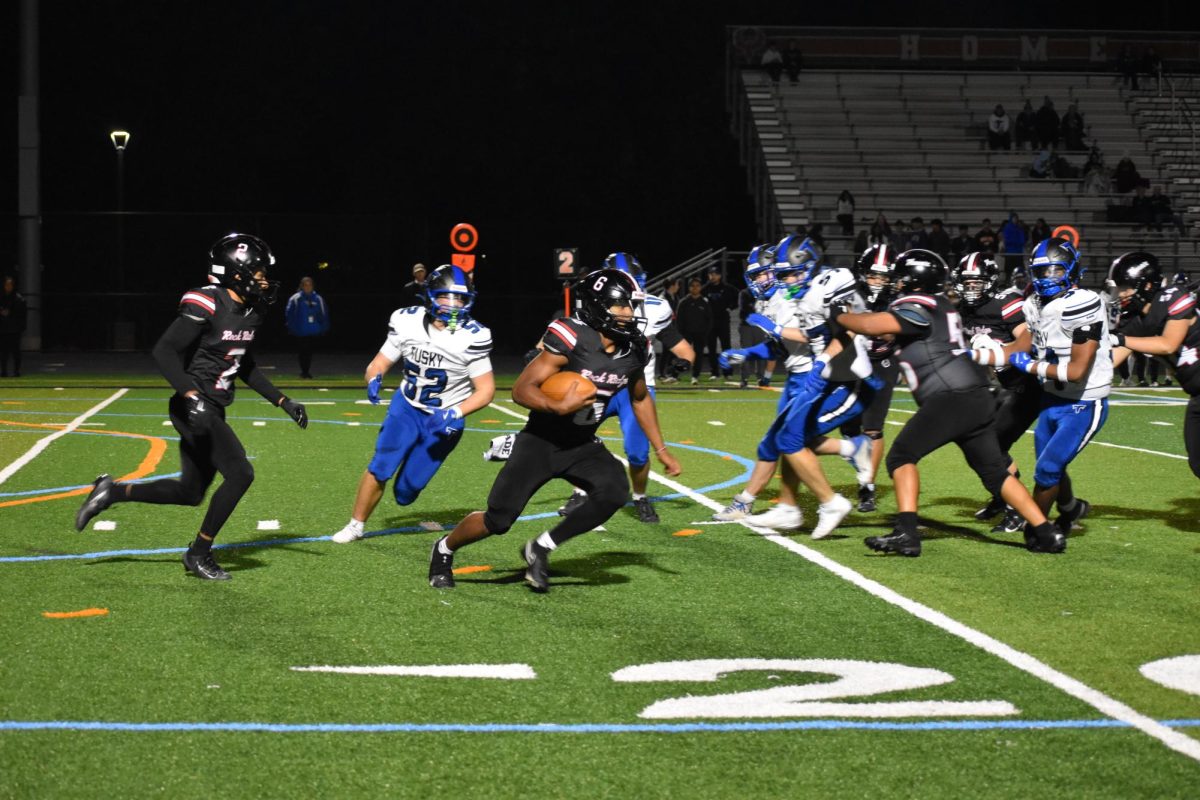
![Phoenix gets in position to initiate the beginning of an intense game. “It's coming to the end of the season here, so [our goal] is to just focus on working harder,” senior lineman Ryan Abbondanza said.](https://theblazerrhs.com/wp-content/uploads/2025/10/DSC_0042-1200x800.jpg)































Starting this 2025-2026 school year, Rock Ridge adopted a new attendance policy to mitigate chronic absenteeism – the issue when a student misses 10 percent or more of a school year. After a quarter of data analysis, the verdict is clear – the new policy is working.
Two LCPS School Board policies, Policy 8140 and Policy 8350, are the driving factors behind the success. Policy 8140 addresses student attendance requirements and procedures, concerning absences, tardiness, and truancy by enforcing accountability in parents and students and upholding administration intervention. Policy 8350 furthers that by classifying interscholastic sports as a privilege, which can be revoked in the absence of good attendance. At Rock Ridge, tardies may lead to a student’s inability to participate in an after-school event.
Chronic absenteeism has been a widespread struggle for many schools throughout America since the pandemic, with Rock Ridge being no exception. In Quarter 1 for the 2024-2025 school year, the attendance rate was 95.81 percent, there were 4273 tardies, and 13.4 percent of the student body was considered chronically absent. In Quarter 1 this year, however, the attendance rate was 96.76 percent, there were 3694 tardies, and only 10.7 percent of the student body was considered chronically absent – an almost three percent decrease from last year.
Principal John Duellman believes that this improvement puts Rock Ridge on track to minimize absenteeism. “691 students [have not missed a day of school this quarter],” Duellman said. “To me, that is a fantastic number – it’s about 40 percent [of the student body]. That’s exactly where we would want to be, and I’d love to see that number get even higher.”
School administrators credit this improvement to stricter policies and clearer expectations. “I’ve seen a huge improvement because we’re requiring doctors’ notes for all appointments,” attendance secretary Mary Howard said. “People used appointments as a way to get out of school all the time with no need to back that up. I would [in the past] have probably 50-60 kids a day with appointments, and that was a lot. Now that we’re requiring doctors’ notes, people are using that as an excuse less, because now they know they have to back it up. [As a result,] we have seen a huge drop in dismissals and tardies that are a result of appointments.”
However, some students believe that the policy does not work to their benefit. “Not being able to participate in your practice that day, or [tardies] leading up to a detention can lead to unhealthy factors in a student’s day to day life,” junior Tristan Thompson said. “If [students are] late, they might feel that [coming to school is] not worth it. Another thing about [the] new policy change is where you [now] have to get the doctors pass, and your parent can’t just call in and say, ‘Oh yeah, [the student] was doing [something unavoidable].’”
This shift has not only affected the study body, however. With less students absent, the additional [responsibilities] of teachers and staff have lightened. “It’s a lot of work on the teacher’s part when a student is absent to get them caught up,” Student Support Advisor Elizabeth Bush said. “Whereas if they were just in class in the first place, they wouldn’t have to have that additional amount to get them caught up. Teachers are willing to do it because they love teaching, and they love being with the students, but it adds a whole extra burden if they have 150 students, and let’s say even 10 percent, 15 of them are chronically absent. That’s a lot of additional burden on the teacher to provide 15 individual students with what they need along with their classes every day.”
Fortunately, the attendance changes have not been a major problem for athletes in the fall season. “I think [administrators] initially thought it was going to be tough, but I think we really only held three or four kids out the whole fall for events, not practices,” Athletic Director Patrick McNanley said. “So I think there has been a priority put into [attendance]. And [for] a couple of the instances [in holding meetings with absent students], there was genuine remorse. We had incidents like that, but I think overall, [the new policy] has been a huge part of [the improvement in attendance.]”
To combat chronic absenteeism, Rock Ridge administrators and teachers have decided to hold meetings with students with less than an 80 percent attendance rate in DE classes – a policy completely independent of the School Board. “If [students] don’t meet the attendance standards for college, they don’t get the credit, period,” Duellman said. “We kind of negotiated and said, ‘Listen, we’ll sit down [with students who have low attendance].’ [The meetings were] actually an initiative with Dr. Marcus and Ms. Prince, who got together and kind of coordinated and got this concept in place. The colleges love it, because then we’re kind of counseling students into behaviors that we want to see.”
Evidently, from teachers to students to administrators, chronic absenteeism is a difficult and complex issue, but not an unsolvable one. As Rock Ridge works to strengthen attendance numbers and incentivize more students to stay in school, it also hopes to prepare students for a future outside of school. “On time behavior is probably one of the most valued things in the corporate world, the business world, and in the workplace,” Duellman said. “[Out] of anything that we can teach you guys, being on time, being the first one there, being the last one there, and being prepared for your day is probably one of the most important traits that you can have.”