



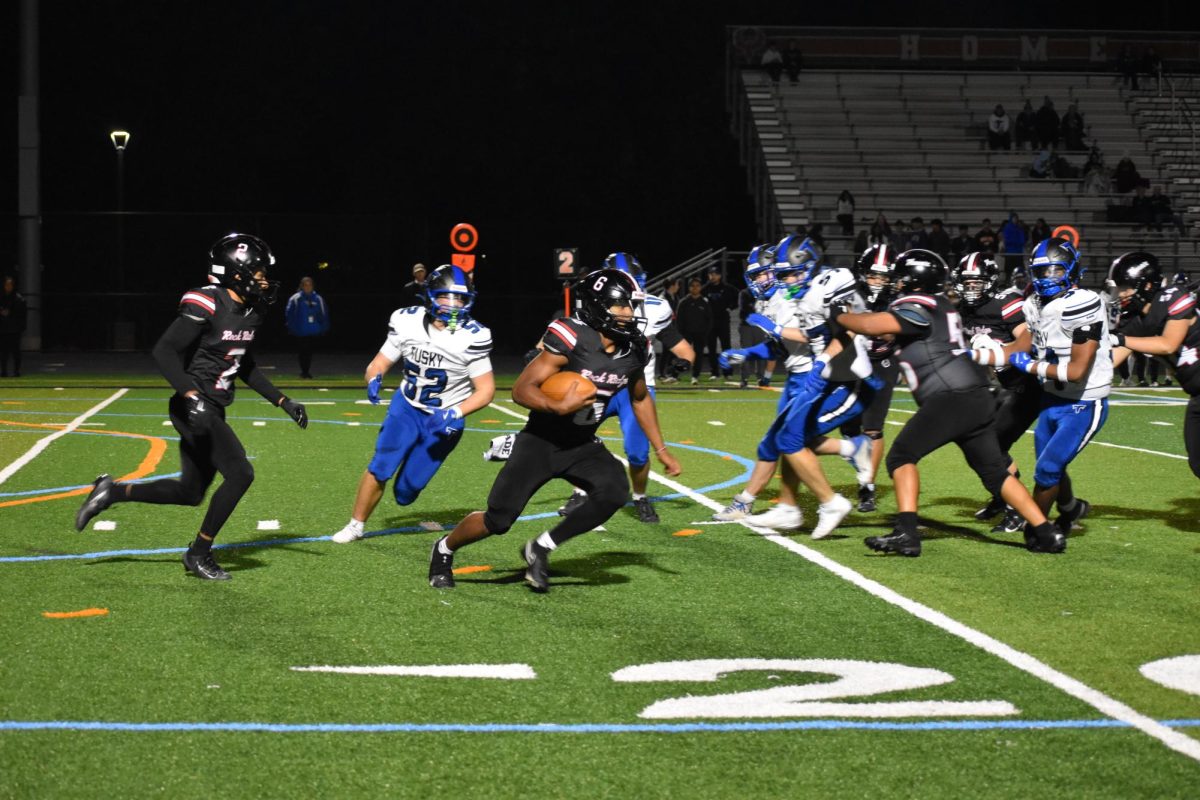
![Phoenix gets in position to initiate the beginning of an intense game. “It's coming to the end of the season here, so [our goal] is to just focus on working harder,” senior lineman Ryan Abbondanza said.](https://theblazerrhs.com/wp-content/uploads/2025/10/DSC_0042-1200x800.jpg)




























If you were to walk through the halls of Rock Ridge between classes, you’d probably hear the same familiar lines: “I’m so screwed for this math test,” “I totally bombed that DBQ,” or, arguably the most infamous one, “I didn’t study at all.”
Yet, more often than not, these students walk away with A’s. Everyone knows it. The students who undersell their efforts know it, their friends know it, and even their teachers are probably aware of it as well. After all, we are the 17th best performing high school in the state of Virginia. Admitting effort, however, has just become socially unacceptable. After all, to seem smart is to seem effortless, and trying “too hard” is often seen as something to hide to avoid judgement in such a cutthroat culture.
This contradiction, undermining effort while subtly achieving, does more than just confuse. It reflects a culture where honesty about struggle seems like a liability, all in order to portray success as something that must reflect effortlessness. It’s known as “effortless perfection,” the phenomenon where people appear naturally smart without showing any visible effort.
Hand-in-hand with the downplaying of effort, conversations about grades, test scores, and college decisions become ominously vague. Numbers are rounded, rejections and deferrals go unmentioned, and daily schedules are framed to make them seem little more than unprepared.
It’s a condition psychologists coin as “Impostor Syndrome,” a psychological pattern where high achievers doubt their skills, feel like frauds, and fear being exposed despite evidence of success, attributing accomplishments to luck or deception rather than confidence. While not uncommon in adults, imposter syndrome is not something that should be seen very often in a school setting. I suppose we can thank the college admission arms race for that.
The college admission arms race isn’t theoretical; in fact, it’s extremely prevalent at Rock Ridge. Currently, Rock Ridge ranks #2 in Loudoun County, with over 60% of students taking and passing at least one AP exam. To put it into a national context, only a little over 22% of the class of 2024 passed an AP exam. Furthermore, Rock Ridge is only slightly behind nationally recognized schools like Thomas Jefferson High School for Science and Technology and Langley High School in state rankings, meaning our culture rivals that of elite, some admission-based, programs.
At Rock Ridge, this self-doubt manifests in two ways: people deflating themselves for the benefit of others or people inflating themselves to their own benefit. Some see the former as an almost admirable part of Rock Ridge’s culture. “I actually really like these people that deflate themselves,” senior Aniketh Malipeddi said. “They’re trying to make their friends feel better. That’s what they’re doing.”
Those who deflate themselves often also, by chance, motivate others to work harder and find something to do. Human nature is inherently competitive, and even more so at Rock Ridge; by deflating, or “hiding,” what some students do results in other students doing whatever they can to try to outperform their peers. When students don’t know what other students are doing, though, they tend to work harder since there is no baseline to compare their efforts to. “The issue with how [the gatekeeping] culture at Rock Ridge works is that there’s no payoff,” junior Henry Wo said. “No one really knows what everyone else is doing, which forces them to try a lot harder.”
Since the end goal of all high school students is to accomplish all they can to curry favor for college admissions, this competition can help cultivate true student potential.
However, this masks the real issue caused by Rock Ridge’s competitive environment–people lying about themselves just to fit in. Instead of impostor syndrome, this phenomenon is known as mythomania. Mythomania is a psychological pattern where one tells elaborate lies about their achievements in order for admiration and acceptance from others. Mythomania shows itself in many ways, though at Rock Ridge it’s used to mitigate low self-esteem. “They [people who inflate themselves] lie about what they’re doing, and then they’re using that to gain social standing,” senior Neeraj Dandamudi said.
Though competitive environments can foster healthy competition, mythomania reflects an underlying negative aspect of pressure-intensive environments. “We’re in the Rock Ridge competitive environment,” Malipeddi said. “You want to make yourself feel comfortable. You don’t want to feel like less than the people you’re surrounded by, so you lie about being better than you are.”
These trends of conditions like mythomania taking hold of students in Rock Ridge aren’t just an isolated issue. Furthermore, another study from the American Psychological Association found that 83% of teens find academic pressure to be a top source of their stress. Research by psychologist Suniya Luthar further reveals the effects of competitive schools, showing that negative behaviors like depression and anxiety are two to three times more likely in adolescents from high-achieving schools when compared to the national average. Considering that Rock Ridge drastically exceeds national averages, with over 60% of students passing AP exams compared to the nation’s 22%, the pressure may very well be higher, setting the groundwork for dishonesty, both deflation and inflation, that has now become normal.
This culture doesn’t end at graduation, however. It continues throughout undergraduate school and even into the workforce. Sure, the pressure might ease as students start to realize not everyone is trying to be better than you, but the patterns often remain, influencing how you confront problems, stress, success, or feelings of inadequacy.
Even now, before these patterns begin to set in, Rock Ridge students face an almost impossible ultimatum. People who deflate themselves are being dishonest. People who inflate themselves are being dishonest. But admit the truth about how hard you worked and risk becoming quietly judged and seen as a “try hard.”
Tomorrow, the hallways will fill up with the same complaints. “I didn’t study at all.” “I’m totally screwed.” “I might’ve just dropped a 12% on my quiz.” This cycle won’t end. According to research, it will continue and stick with students throughout college, into the workforce, and the ultimate goal of becoming the best slowly moves further away. Students are functioning on competition, desperately hoping that if they come off as effortless, nobody will notice that they’re almost running on empty.