

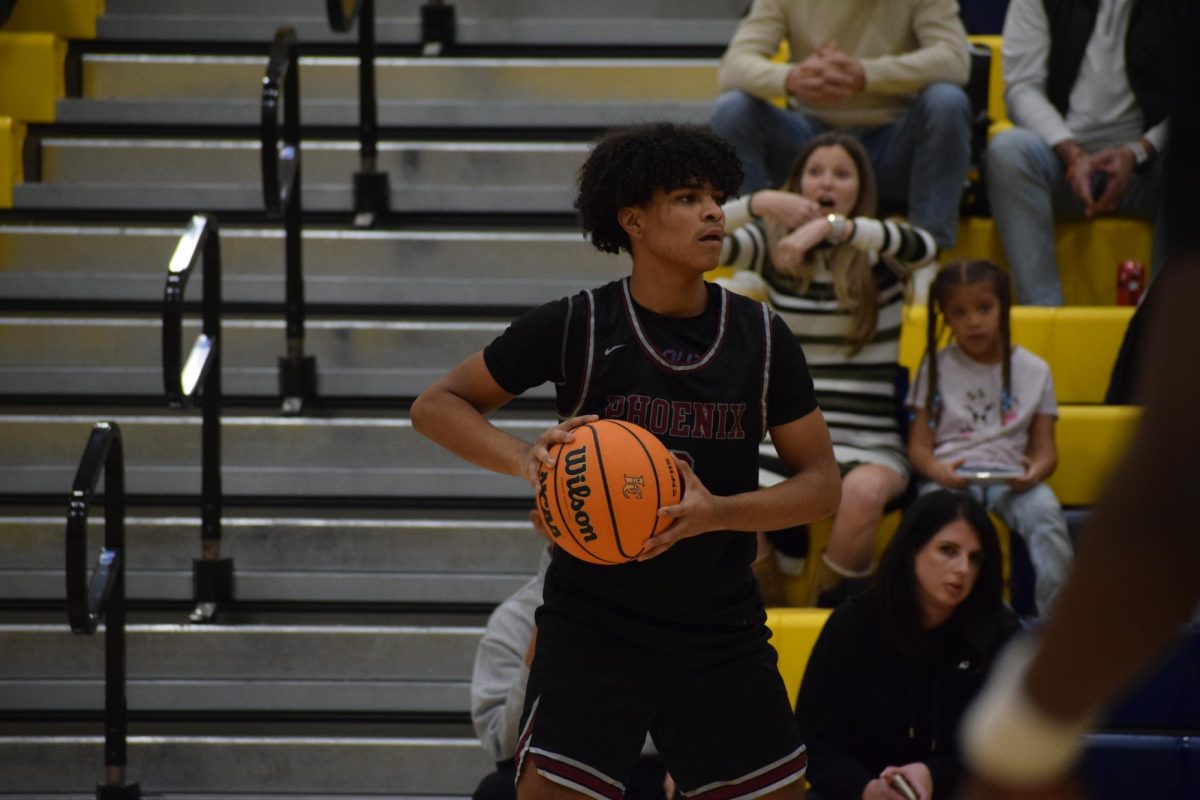
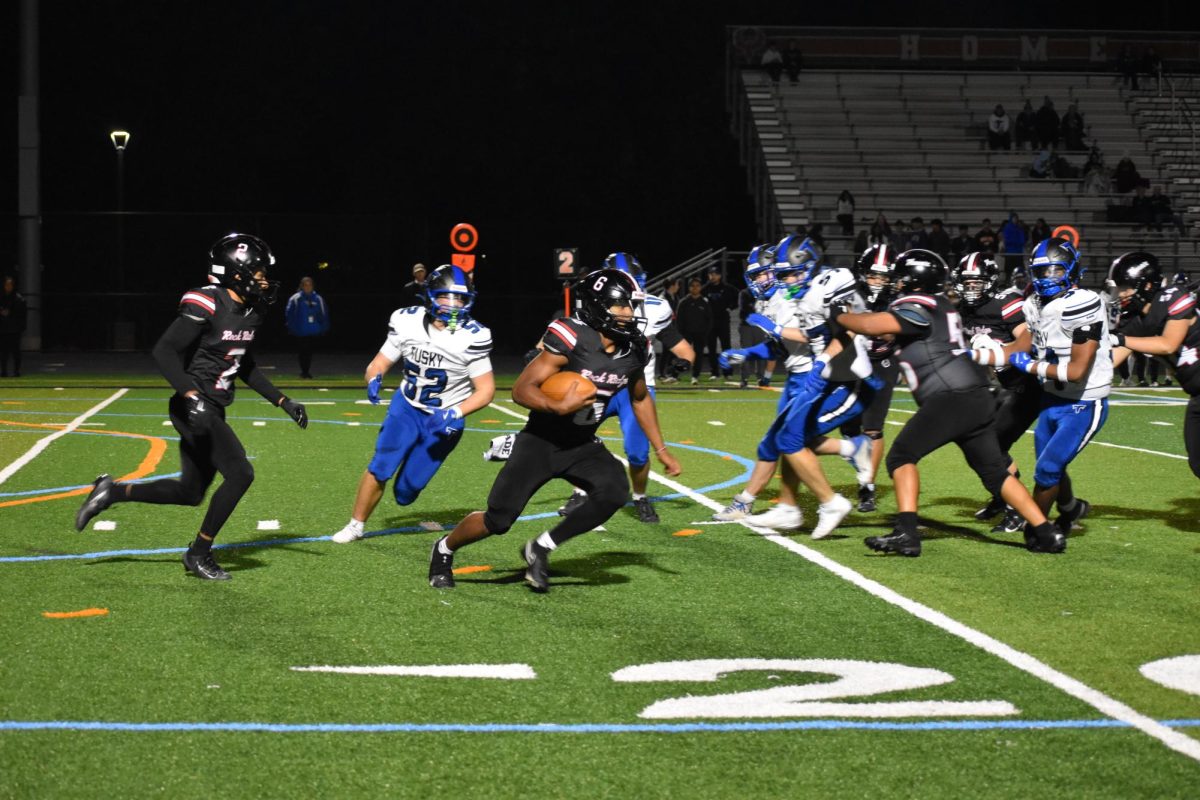
![Phoenix gets in position to initiate the beginning of an intense game. “It's coming to the end of the season here, so [our goal] is to just focus on working harder,” senior lineman Ryan Abbondanza said.](https://theblazerrhs.com/wp-content/uploads/2025/10/DSC_0042-1200x800.jpg)
















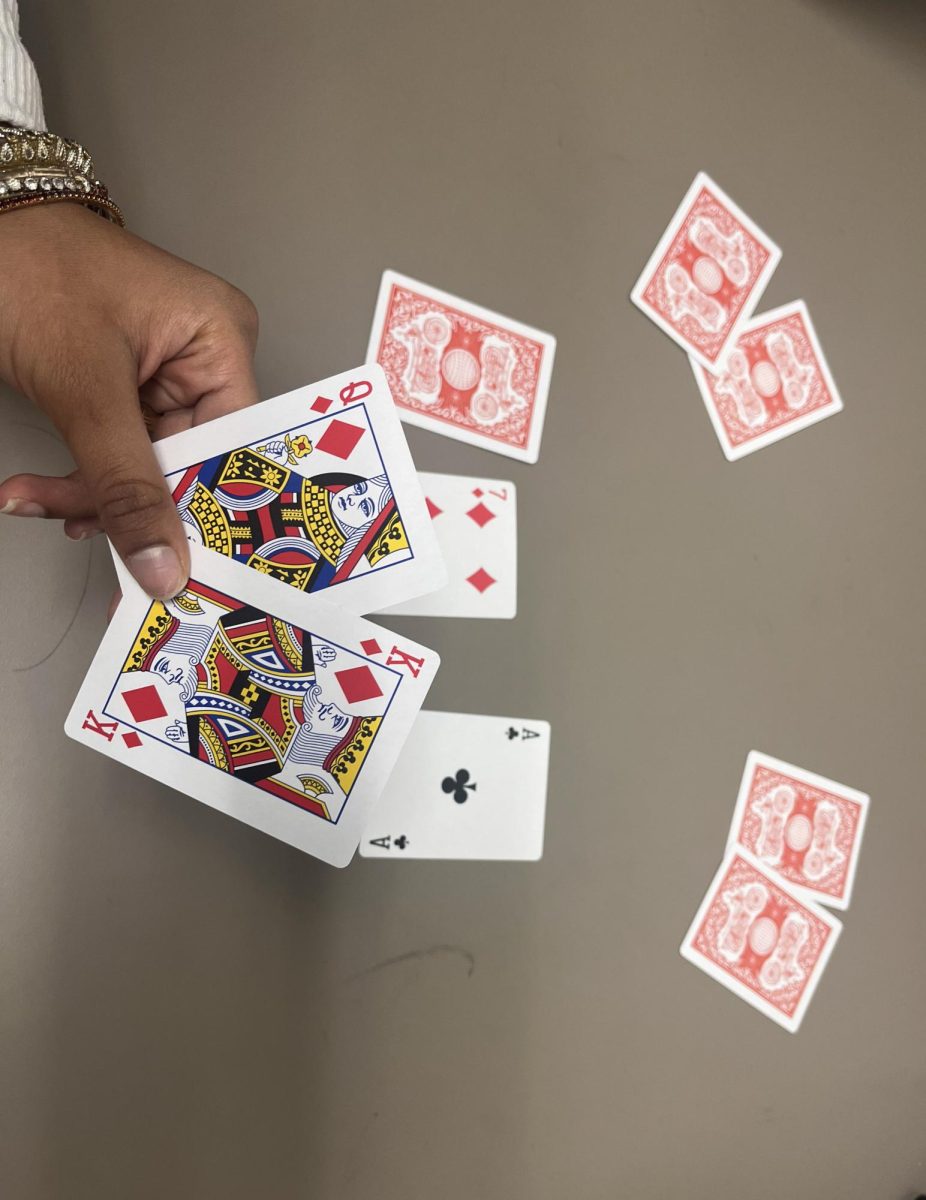


The bell has rung as you make your way to your lunch table. You wonder what you and your friends will play together—will it be Monopoly, Jenga, or UNO? Sitting down, your anticipation grows. Finally, you see your friends making their way over to you. Spotting a deck of cards in their hand and a handful of spoons, you wonder what you’re playing today: Spoons?
Not exactly.
Your friends reach the table, proclaiming the game you’ll play today: poker.
This is a reality for many teens. A 2026 study by Common Sense Media found that 36 percent of boys, ages 11–17, reported gambling in the past year, with 12 percent of all boys participating in traditional, non-digital gambling, such as poker or the lottery.
This growing national trend is taking hold in the Rock Ridge community. “I have [seen gambling] outside and inside of school,” sophomore Talay Uhing said. “[From] free periods like brain break and advisory, [to] the cafeteria or when a teacher isn’t present in the classrooms. Sometimes [in] the hallways too, if it’s during a busier area where teachers can’t keep track of their students.”
Low-stakes poker among friends didn’t just become a hobby at Rock Ridge today; in fact, its influence can be traced back a couple of years ago to the Board Game club.
“Two years ago, after one of the DECA trips, everyone came back with just like ‘Poker, poker, poker, poker,’” Board Game club advisor and science teacher Michael Clear said. “I let it go for a minute, but then as soon as it was like the whole ‘Oh, we’re gambling money,’ I was like, ‘No, no, no, no, we can’t do that,’ so we shut that down real quick.”
Within Virginia, gambling is illegal for minors under law § 58.1-4128, which prohibits anyone under 21 years of age from placing wagers; however, the gambling in Rock Ridge is rarely for money— it’s for fun and socializing, as well as making new friends.
“It’s just fun to [play poker],” sophomore Ansh Shah said. “I like bluffing, [and] I like trying to find out when my friends are lying or not. The overall gist is just to have fun and not play with real money when I play poker.”
In fact, some find that the game bridges the gap between people of different ages. “[I play poker for] social bonding,” sophomore Karthik Uppalapati said. “It’s just fun because it’s a way to meet with multiple people of different age demographics.”
Although the vast majority of the pop-up poker games at Rock Ridge are money-free, when asked about these rare low-stakes poker games in the halls or during lunch, Rock Ridge administration vowed to ramp up its policing and supervision efforts.
The true high-stakes hands are occurring, however, outside of the school.
“They usually bet around $10 for a buy-in [outside of school],” said Uhling. “[Sometimes], players, during the round, increase their buy-in, so it’ll get up to even $100 for one game per player.”
In games outside of school, the cost for a hand can go even higher. “It could go anywhere from between five to 200,” one anonymous freshman poker player said. “[I’ve] bet 20, and I got 500.”
Beyond the problem of students gambling with money, some students have found themselves becoming addicted and not able to self-regulate.
“For how I see gambling, I don’t know the science behind it, but it triggers something in [me] where I want to keep winning, but I can keep going even if I lose,” another freshman poker amateur said. “That’s how I see it. It can be a very addicting thing.”
This can create an issue, as the socially acceptable nature of gambling prevents teens from seeking help when they develop an increasing affinity towards gambling and possible addiction.
“A lot of teens are doing gambling because their friends are gambling, and they gamble together, [so] because everybody’s doing it, they don’t perceive it as a problem,” chief clinical consultant for Mosaic Consulting and Counseling Services and board member of the Maryland Council on Problem Gambling Deborah Haskins said. “So even the name we use in the field, ‘problem gambling,’ for most people, it’s kind of an oxymoron because they don’t see it as a problem at all.”
Without being treated, gambling can create an addiction that is similar to the dopamine released by drugs.
“Gambling works [similar to] drugs, [as] they kind of give you a big rush,” Dartmouth associate professor of Psychological and Brain Sciences Kyle S. Smith said. “[It] activates dopamine and other things [which] the brain really latches on to and says ‘Do that again,’ and so with gambling, it’s tapping into the same processes. [But] I wouldn’t say that playing poker is going to give you the same rush as drugs do, [so] a minority of people develop a problem [including] adolescents.”
What Smith says is similar to the findings in a 2013 study conducted by Anselme and Robinson, which found that gamblers equated their experience of gambling to drugs.
Another reason for the risk of addiction in teens is the unfinished growth of the brain which prevents rational decision making. “The reason is somewhat pop sciencey, but it’s true – [it’s] the prefrontal cortex,” Smith said. “[In] adolescents and kids, the prefrontal cortex part isn’t developed, and so the bottom up voice—that latches on to rewards and has you repeating behaviors that lead to [addiction]— is going to win more often.”
This might explain some of the social habits of Gen Z, where gambling has become prevalent. In a 2024 poll by Fairleigh Dickinson University, they found 10 percent of young men in the U.S. show behavior indicating a gambling problem. Though gambling addiction is slightly lower among teens, treating the addiction is the challenge.
“So we say statistically speaking, one to three percent of the general population has an addiction to gambling,” Haskins said. “Unfortunately, we have less than five percent that will actually seek professional help: call the 1-800-MY-RESET number, or go to a 12-step meeting, like GA, [also known as] Gamblers Anonymous.”
Haskins’s concerns echo the fact that only a minority of gamblers end up seeking help. In fact, a 2016 study by Yao and Potenza found that only 10 percent of addicts seek formal help or other types of intervention, with many reasons for avoiding intervention being shame, denial, and wanting to handle the problem alone.
But while the risk is prevalent, students at Rock Ridge have found the ability to self-regulate, preventing dependence.
“I’ve just been told from a young age that it was just a bad idea because you can kind of lose all your money with the gambling craze,” senior Arya Lele said.
Though self-regulation is currently working, prevention has been shown to stop addiction.
“What I know works [to stop addiction] is prevention,” Haskins said. “There’s different categories of prevention. Primary prevention is where you’re providing screenings so that you’re trying to get early detection.”
As gambling grows, it’s important to know where the boundary between good and bad begins. “There were still some people playing [poker on] the side, [and] it’s fine if it’s just a game for fun,” Clear said. “But the problem is that they’ve secretly bet the money without us teachers knowing.”
But, when students find themselves slipping into an addiction, it’s important they remember the future. Addictions can severely affect and get in the way of their aspirations, as well as other personal goals.
“What’s your dream,” Haskins said. “What are your visions? Understand that if you fall into an addiction, it’s going to disrupt the dream. [For] some people, they never get to implement the dream. When you start participating in certain games and gambling, and you’re starting to notice you’re increasing your behavior, remind yourself of your dream.”